
Why AI-Powered CRM Systems Are Redefining Franchise Growth and Execution
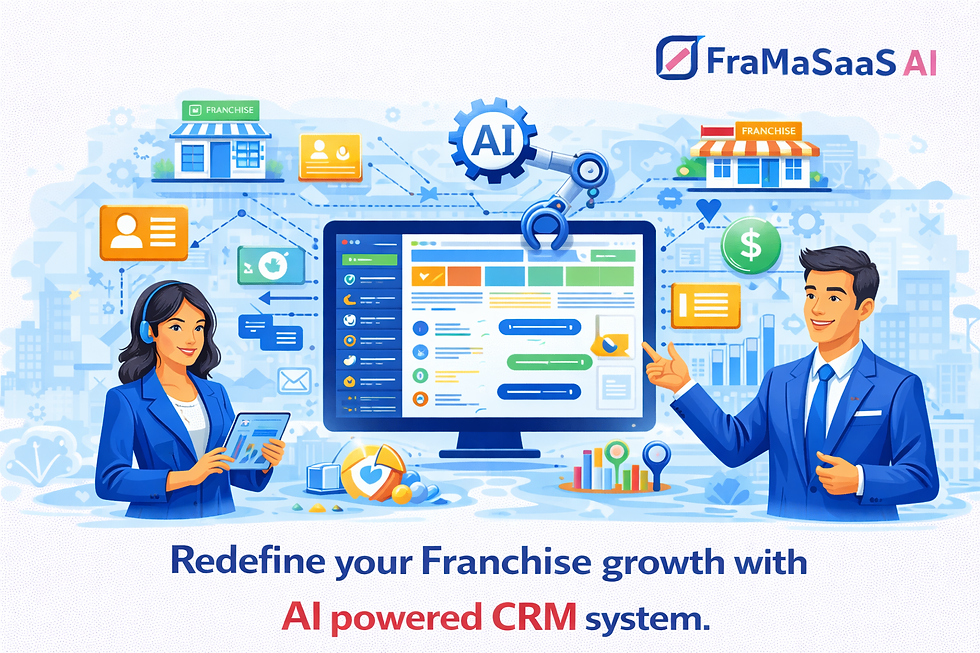
Franchise businesses generate massive amounts of customer, lead, and operational data every day—across locations, channels, and teams. Yet for many leadership teams, that data rarely translates into faster decisions, consistent execution, or predictable growth. Reports are reviewed after the fact. Opportunities are missed. Performance varies from one unit to another.
This is why AI-powered CRM systems are becoming a strategic necessity rather than a functional upgrade. When intelligence is embedded directly into customer and franchise operations, CRM shifts from being a record-keeping tool to a decision-driving platform. FramaSaaS AI is built precisely for this shift—helping franchise networks turn data into coordinated action at scale.
The CRM Problem Most Franchises Don’t Talk About
Traditional CRM platforms were designed to store information: leads, customers, tickets, and interactions. They work well for visibility, but struggle when scale and complexity increase.
As franchise networks grow, common limitations appear:
Customer and lead data is fragmented across locations
Follow-ups depend on manual reminders and local discipline
High-performing franchise units are difficult to replicate
Underperforming locations are identified too late
Leadership sees activity, not execution quality
The CRM tells you what happened. It rarely tells you what to do next—or does it for you.
Why Intelligence, Not Automation Alone, Is the Missing Layer
Many organizations try to fix CRM limitations with basic automation: workflows, rules, and alerts. While helpful, rule-based automation still depends on human judgment to prioritize, intervene, and course-correct.
AI changes this equation.
An AI-enabled CRM does more than automate tasks. It learns patterns, predicts outcomes, and recommends or triggers actions—continuously and consistently across the network.
This shift moves CRM from a support tool to an operating system for growth.
What AI-Powered CRM Systems Do Differently
High-impact AI-driven CRM platforms share four defining capabilities:
1. Predictive Intelligence
AI analyzes historical and real-time data to forecast lead conversion, customer churn, service delays, and unit-level performance risks—allowing proactive interventions instead of reactive fixes.
2. Automated Decision Flows
Instead of static rules, AI dynamically prioritizes leads, escalates service issues, and routes tasks based on urgency, impact, and context—without manual supervision.
3. Network-Wide Standardization
Best-performing behaviors are identified and embedded into workflows, ensuring that every franchise location follows proven practices—not individual interpretations.
4. Continuous Optimization
The system improves over time. As more data flows in, recommendations become smarter, workflows more efficient, and outcomes more predictable.
How FramaSaaS AI Reimagines CRM for Franchise Businesses
FramaSaaS AI is not a generic CRM layered with AI features. It is purpose-built for franchise ecosystems where consistency, visibility, and execution matter as much as customer engagement.
Unified Franchise Intelligence
Customer, lead, ticketing, and operational data from all franchise locations is centralized into a single platform—giving leadership a real-time view of network health.
AI-Driven Performance Signals
FramaSaaS AI identifies early indicators of underperformance, delayed follow-ups, declining engagement, or service bottlenecks—before they affect revenue or brand perception.
Intelligent Workflow Automation
Lead assignment, follow-ups, escalations, service requests, and compliance actions are triggered automatically based on AI-driven insights—not manual checks.
Role-Based Governance
Franchisors maintain control and oversight, while franchisees get clear, guided execution—reducing friction without slowing local operations.
From CRM Visibility to Execution Control
Industry: Multi-location franchise business
Situation:
CRM data was available, but follow-ups varied by location
Service tickets required manual coordination
Leadership lacked early visibility into performance gaps
FramaSaaS AI Approach:
The CRM was enhanced with AI-driven prioritization, automated task routing, and performance intelligence across all franchise units.
Business Impact:
Faster lead response and higher conversion consistency
Reduced service resolution time through automated escalation
Early identification of underperforming locations
More predictable customer experience across the network
The CRM evolved from a reporting tool into an execution engine.
Why Decision-Makers Are Replacing Traditional CRMs
Franchise leaders today are not asking for more dashboards. They want systems that reduce dependency on manual oversight and scale execution reliably.
They choose FramaSaaS AI because it:
Aligns customer engagement with operational execution
Embeds intelligence into everyday workflows
Scales best practices automatically across locations
Delivers measurable impact on growth, service quality, and efficiency
In a distributed business model, intelligence is the only way to scale without losing control.
Conclusion
Growth in modern franchise businesses is no longer limited by opportunity—it is limited by execution. Systems that only record activity cannot support that scale. What franchises need are platforms that think, prioritize, and act.
That is why AI-powered CRM systems are redefining how franchise networks grow, serve customers, and maintain consistency across locations. By combining intelligence, automation, and governance into a single platform, FramaSaaS AI transforms CRM from a data repository into a driver of real business outcomes.
If your CRM shows you everything but still requires manual effort to make things happen, the problem isn’t adoption—it’s capability. With FramaSaaS AI, customer data finally turns into coordinated decisions, consistent execution, and scalable growth.